
Carver County Supervision Split
Carver County does not route all probation and post-prison cases to one office. Carver County Court Services Adult Division supervises misdemeanor, gross-misdemeanor, reduced-felony probation, and pretrial supervision. The Minnesota Department of Corrections Chaska office handles adult felony matters. It also supervises people who leave a Minnesota prison on supervised release and live in Carver County. The conviction level and custody path determine which office can verify the case.
This division matters after release. A county-jail release does not, by itself, show that probation began. A DOC prison release does not mean the executed sentence has ended. Start with the court docket when the person received local probation. Start with the Minnesota DOC Public Viewer when the person served a state-prison term. If the record names an agency or agent, use that information to reach the right office instead of calling both at random.
Note: The Carver County Jail roster confirms an exit from that jail, but it is not a countywide probation roster.
Carver County Parole and Probation
Probation is a court-ordered form of community supervision. It may follow a jail term, begin without a jail term, or continue after release from the Carver County Jail. Minnesota usually calls the community portion of an ordinary determinate prison sentence supervised release. Parole is narrower. The Minnesota Supervised Release Board has parole authority for specified life, indeterminate, certified-adult, and certain criminal-sexual-conduct cases. Ordinary post-prison supervision should not be labeled parole just because the person left prison before the sentence expired.
| Supervision type | How it begins | Carver verification route |
|---|---|---|
| Probation | A court places the person under conditions instead of, or in addition to, confinement. | Read the Carver court case, then contact Court Services or DOC Chaska based on the case level. |
| Supervised release | A person leaves Minnesota prison to serve the community part of an executed sentence. | Check DOC Current Status, the effective date, supervising agency, and agent. |
| Parole | The Supervised Release Board grants release in a case within its statutory authority. | Review the Board schedule and minutes, then confirm the actual post-hearing status with DOC. |
| Pretrial supervision | A court releases a person while the criminal case remains pending. | Use the court docket and Carver County Court Services, not a post-prison search. |
A board hearing is not a release event. An agenda only shows that a matter is expected for review. Minutes are the closest public decision source identified, but even a grant can lead to another sentence or legal status rather than direct community release. The Board schedule, agendas, minutes, and recordings should be read with DOC Current Status after the expected event.
- Supervised release
- The community portion of a Minnesota executed prison sentence, served under DOC authority.
- Probation
- Court-ordered community supervision that can involve local or DOC agents.
- Parole
- Release authorized by the Supervised Release Board for a limited class of eligible sentences.
- Discharge
- The end of the sentence or supervision obligation shown by an official court or corrections record.
Verify Carver County Post-Release Supervision
A reliable check starts with the kind of custody the person left. The official Carver County released-inmate search and records path can establish a jail exit, while DOC data can establish a prison release to supervision. Court records fill the gap for local probation. Use a full name, date of birth when known, court file number, or MNDOC Offender ID to reduce mistaken identity.
- Identify the release source. Determine whether the person left Carver County Jail, a Minnesota prison, or court on a non-prison disposition.
- Check DOC status for a prison case. Search by MNDOC Offender ID when possible. Record Current Status, its “as of” date, current agency, and agent.
- Read the court docket for probation. Use Minnesota Court Records Online to confirm the public disposition, probation order, revocation, warrant, or discharge entry.
- Route by case level. Contact Carver Court Services for its lower-level and pretrial caseload. Contact DOC Chaska for adult felonies and state-prison supervised release.
- Ask a narrow question. Request confirmation of the supervising office and public status. Do not assume an agent can disclose private corrections data.
- Confirm how supervision ended. Look for a DOC expiration or discharge record or a court discharge entry. Mere absence from an online viewer is weak proof.
The DOC viewer can show “Under Supervision as of” a stated date along with an agency and agent. That is strong current evidence that the person left prison but remains under DOC jurisdiction. “Assigned to Work Release” is different. Work release is a structured placement under DOC authority, not an ordinary return to unrestricted community life. When the viewer no longer returns a person after final discharge, DOC Records and the sentencing court are the durable sources.
The successful manifest capture of an official DOC result showing an under-supervision record illustrates the type of status field used after prison release.
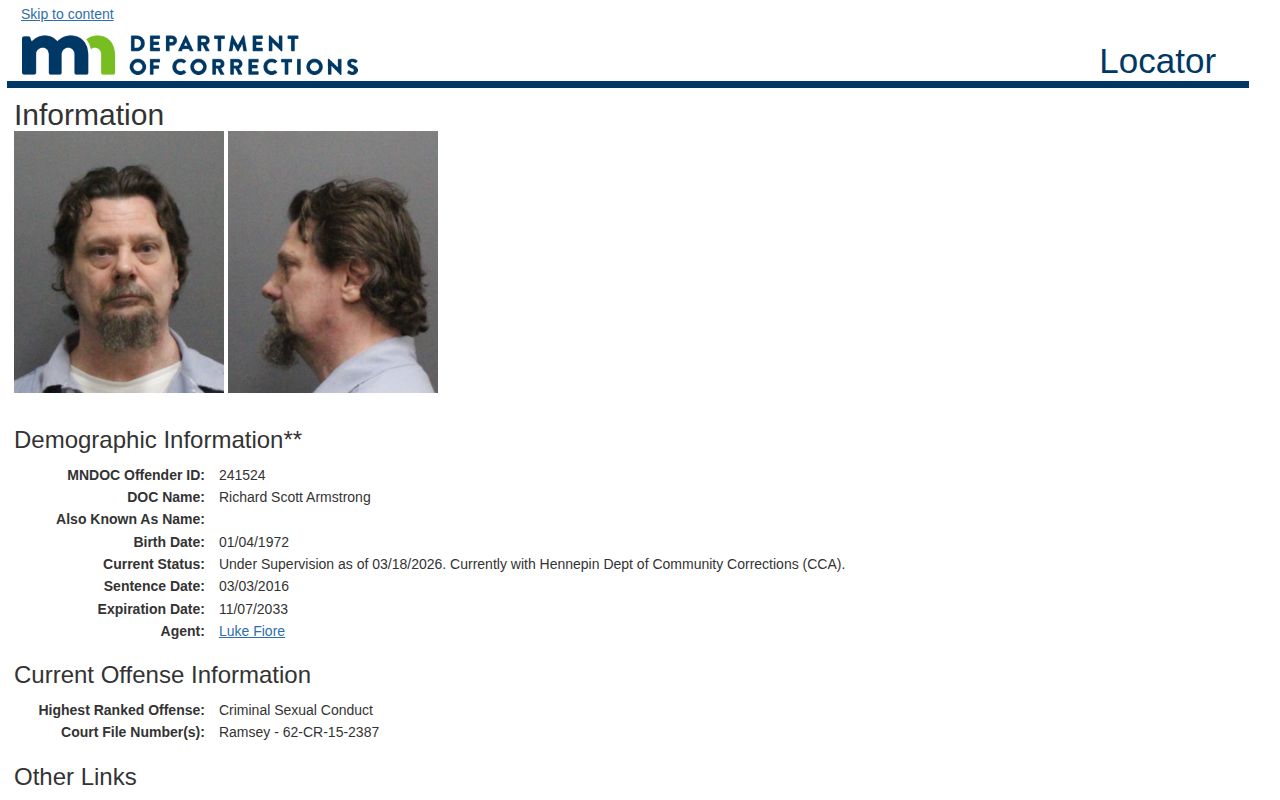
The field wording and effective date matter more than the arrival of an expected release day.
Carver County Supervision Contacts
Two Chaska offices serve different adult populations. Carver County Court Services is the local route for misdemeanor, gross-misdemeanor, reduced-felony probation, and pretrial supervision. DOC Chaska is the route for adult felony supervision and people released from Minnesota prisons to Carver County. Office staff can confirm routing and whatever status is public, but confidential case details and treatment information remain protected.
Carver County Court Services Adult Division
604 East 4th Street
Chaska, MN 55318
Phone: 952-361-1460
Email: ctservicessupport@carvercountymn.gov
Monday through Friday, 8:00 a.m. to 4:30 p.m.
Minnesota DOC Chaska Office
207 North Chestnut Street, Suite 200
Chaska, MN 55318
Phone: 952-346-4880
Fax: 952-361-3430
For a record that has left the public viewer, contact Minnesota DOC Records Management at 651-361-7330 or CO-Records.DOC@state.mn.us. The DOC mailing address is 1450 Energy Park Drive, Suite 200, St. Paul, MN 55108. Ask for the public supervision, release, or discharge record tied to the MNDOC Offender ID and court file number.
Note: Office assignment can change, so use the agency and agent shown on the newest dated DOC result when available.
Carver County Reentry After Release
Post-release supervision is only one part of returning to Carver County. The county operates Jail Mental Health and Offender Reentry navigation through Behavioral Health. The official county supervision report also identifies a jail reentry coordinator. These resources can help a released person or family find the right local service, but they do not confirm custody, probation, or DOC status.
The Jail Mental Health and Offender Reentry program can be reached at 952-442-4437. A person who needs status proof should still use the court, DOC, or supervising office. Keeping those tasks separate avoids treating a service navigator as a records custodian or asking a supervision office to perform a service referral it does not manage.
Carver’s local structure supports a clear sequence: verify the legal status first, confirm the right supervision office next, and then use reentry navigation for service needs. That sequence is especially useful when a family has only a jail-release date and does not yet know whether the case moved to probation or DOC supervision.
Carver Supervision Warrants After Release
A warrant can explain why a person who was released is later arrested, but it does not prove that the person is now in the Carver County Jail. A probation-violation warrant, conditions-of-release warrant, local court warrant, or DOC fugitive listing has a different scope. Check the warrant source, then check the live custody source separately.
The Carver County Sheriff warrant page supports online and telephone checks. The Warrants Division is available at 952-361-1281 during weekday business hours, while dispatch handles after-hours inquiries. Minnesota DOC’s Active Fugitives gateway covers people alleged to have violated the community portion of a DOC sentence while evading authorities. Its tip line is 651-603-0026.
Neither result should be stretched beyond its wording. A local warrant record means legal process is outstanding. A DOC fugitive listing means the agency alleges a supervision violation and is seeking the person. To learn whether an arrest has occurred, check the Carver roster, VINE, or the agency that executed the warrant. For a court outcome, return to the public docket.
Carver Release Conditions and Violations
Supervision conditions come from the court, DOC, Board authority, and the individual case. Public records may show the broad status, supervising agency, a warrant, a revocation filing, or a later discharge. They do not make every case note or personal record public. A violation allegation also is not the same as a final finding.
For probation, read the Carver court Register of Actions for public violation, warrant, revocation, amendment, and discharge entries. For supervised release, use DOC Current Status and contact the named office. VINE can send custody-event notices, but it does not track the full life of community supervision. A release notification says the reporting custodian changed the person’s status. It does not state that all supervision conditions ended.
Minnesota also distinguishes earned compliance credit from earned incentive release credit. Under Minnesota Statutes section 244.41, qualifying compliance may reduce active supervision by one month for each two months of qualifying compliance, subject to policy and risk review. Section 244.46 addresses supervision abatement. That change does not automatically alter the legal expiration date and is not retroactive proof that final discharge occurred earlier.
Confirm Carver County Supervision Discharge
Final discharge needs an affirmative record. For local probation, seek the public court entry showing discharge, satisfaction, or another order ending supervision. For DOC supervision, use the expiration and status information carefully, then request the official record when a precise end date matters. An Expiration Date is about the sentence or DOC jurisdiction. It is not necessarily the prison release date.
The public DOC viewer is limited to people still under DOC jurisdiction. A person may disappear after the sentence fully expires. That absence does not prove when prison release occurred or when active supervision stopped. DOC Records and the sentencing court remain available after the online record is gone. The same caution applies to a missing name in the county jail roster, which has a different purpose and retention window.
Use scope-specific language when recording the result: “released from Carver County Jail,” “under DOC supervision as of the stated date,” “probation discharged by court order,” or “sentence expired according to DOC Records.” Each statement answers a separate question. Together they provide a more accurate supervision history than a single roster or search result can supply.